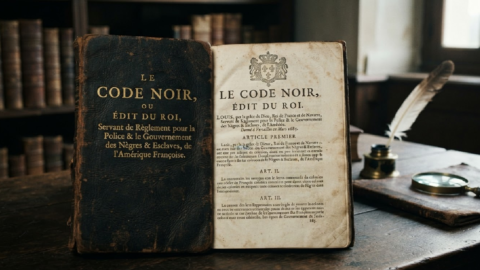

The Code Noir was a French adaptation of a model that had already shaped the world. But enslaved Africans adapted too—in ways that continue to shape St. Lucia today.
The Text of the Code Noir (1685)
Article 9 of the original 1685 Code Noir explicitly allowed it. It stated that if a free man (including a white planter) had children with his enslaved concubine and was not married to someone else, he could marry her . This would then free her and their children, and they would become “free and legitimate”.
This was a genuine legal loophole, not an endorsement of equality. But it was the foundation for the “free people of color” class.
The Reality: Theory vs. Practice
Article 9 created a tension the white elite grew to hate, resulting in:
Discouraged in Practice: By the late 18th century, local authorities effectively discouraged or blocked such unions, viewing them as a threat to the racial hierarchy .
A Tool for Freedom: As a result, most marriages under this article were between free people of color and enslaved partners, allowing them to free family members legally .
A Hypocritical System: White men continued having children with enslaved women out of wedlock, but often refused the marriage that would free their own children. This produced the “illegitimate” mixed-race population that remained enslaved.
Fines for Interracial Relationships
Article 9 of the Code Noir stated that if a free man had children with an enslaved woman who was his concubine, and he was not married to someone else, he could marry her—and she and the children would become free. But if he refused to marry her, there was a penalty:
- He was fined 2,000 pounds of sugar (a significant amount, roughly a year’s wages for a laborer).
- If he was the child’s owner, the child could be taken away and “adjudged to the hospital” (a local charity institution), and the father would never be able to claim them as heirs.
That fine was intended not to punish the relationship itself, but to force accountability. The crown wanted enslaved children to be either freed through marriage or removed from the plantation so they didn’t inherit property.
However, records show these fines were rarely collected. Planters often simply ignored them, and local magistrates looked the other way.
Punishments for Enslaved People
The Code Noir specified harsh physical punishments for enslaved people, regardless of their relationship to a white person:
- Running away – If absent for one month, the slave’s ears were cut off. For a second offense, the hamstring (back of the knee) was cut. For a third, death.
- Striking a white person – Death penalty.
- Stealing – Whipping, branding, or even execution, depending on the value of the item.
These punishments applied across the board—no exceptions for the enslaved partner or child of a white man.
Restrictions on Free People of Color
Free people of color were not subject to the same physical punishments as enslaved people, but they faced legal restrictions:
- They could not hold public office, vote, or serve as judges.
- They were required to show “singular respect” to white people—meaning deference in tone, posture, and behavior.
- They could not marry white people without royal permission (this restriction was added later, not in the original 1685 code, but enforced locally).
- They could not practice certain professions, such as medicine or law, without special permission.
These restrictions weren’t about cruelty—they were about maintaining social order as the colony’s rulers understood it.
Manumission Taxes
Freeing an enslaved person (manumission) was allowed but came with financial consequences:
- In French St. Lucia, a freed person had to pay a tax or fee to the colonial treasury.
- This amount varied, but it was often equivalent to 1/10th or 1/5th of the enslaved person’s value.
- The tax was intended to discourage mass emancipation, which authorities feared would reduce the labor force and destabilize the economy.
Additionally, freed people had to show that they had a means of support—they couldn’t simply be released into poverty, as that would become a burden on the colony.
Why These Rules Were Created
The Code Noir was not purely punitive. It reflected a colonial worldview that saw slavery as necessary for economic survival. The framers believed that:
- A structured, predictable legal system would prevent chaos.
- Allowing some path to freedom (through marriage or purchase) would encourage enslaved people to behave well.
- Punishments needed to be severe enough to deter rebellion.
That doesn’t make the system just—but understanding their logic helps us see why it functioned the way it did, rather than dismissing it as simply “evil.”
“The Code Noir was a legal system designed to manage a difficult reality: a small white population controlling a large enslaved one. It offered incentives for good behavior and severe penalties for disobedience. The fines and taxes weren’t about morality—they were about maintaining control.”