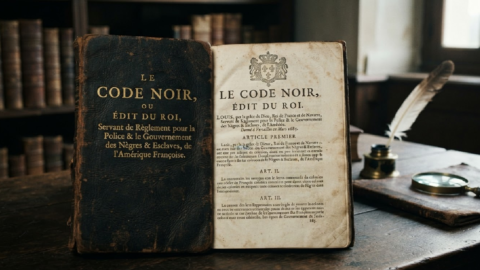

The Code Noir was a French adaptation of a model that had already shaped the world. But enslaved Africans adapted too—in ways that continue to shape St. Lucia today.
The Code Noir created a complex, three-tiered society in the French Caribbean . It was a rigid hierarchy, but not a closed one—legal pathways existed for movement, and a distinct middle class emerged.
Here is the breakdown of the classes and the crucial distinction between those who were born free and those who purchased their freedom.
The Three-Tiered Hierarchy
White Elite (Colons): At the top were white plantation owners and colonial officials who held all political power.
Free People of Color (Gens de couleur libres): This was the crucial intermediate group, composed of freedpeople and their descendants . They were a significant economic force, working as artisans, merchants, and even planters . By 1789, in Martinique, they represented 5.9% of the population.
Enslaved Population: At the base were the enslaved people, legally defined as “movable property” (meuble) with no rights. They were the vast majority, performing the brutal labor on plantations
Born Free vs. Paid for Freedom
This middle class had two distinct origins :
The “Born Free” (Libres de naissance)
Origin: Descendants of freedpeople, often multiracial children born from unions between white men and enslaved women. The Code Noir originally stated that marriage between them would free the woman and children
Status: Many maintained close ties to white society but faced increasing legal discrimination and segregation after 1763 (e.g., restrictions on professions, inheritances, and public spaces)
The “Freedpeople” (Affranchis)
Origin: Individuals who gained freedom via manumission (a master’s act) . The Code Noir permitted this, but authorities later imposed taxes and required permission to control the growing population .
Self-Purchase: A key path was enslaved people using savings (pécule) to buy themselves, especially in cities where they worked as artisans, hairdressers, or seamstresses .
Military Service: Another route, reserved for men, was service in the colonial militia
A Complex and Contradictory Position
While both groups were legally free, their lives were defined by navigating legal contradictions and social prejudice. They could own property and businesses—and even enslave others —but faced racial discrimination and legal restrictions that limited their rights and reinforced a racial hierarchy .
This position created a wedge between them and the enslaved masses. They were a key “buffer” group in the system , but their economic interests in slavery often tied them to the white elite, rather than to racial solidarity.
This complex class structure laid the foundation for the revolutionary upheavals that followed.