
The Papal Bulls: Permission to Conquer and Convert
In the 1400s, the Catholic Church held significant governmental power and worked closely with the civil governments of Spain and Portugal. The Church issued rulings known as papal bulls that dictated status, limited freedom, and permitted the confiscation of land and people in territories that Catholic nations colonized.
In 1452, Pope Nicholas V issued Dum Diversas, which granted Portugal “full and free permission to invade, search out, capture, and subjugate the Saracens and pagans and any other unbelievers and enemies of Christ wherever they may be, as well as their kingdoms, duchies, counties, principalities, and other property”. This was a direct authorization to enslave non-Christians in the name of spreading the faith.
Then in 1493, Pope Alexander VI issued a series of bulls, including Inter caetera, which granted Spain the right to claim lands in the New World in exchange for evangelizing the indigenous peoples. The following year, these papal grants were formalized through the Treaty of Tordesillas, which divided the world into two spheres of influence: Spain would control lands west of a meridian (the Americas), and Portugal would control lands east (Africa, Asia, and Brazil).
The pope granted these powers because the monarchs “were willing to subsidize missionary activities in newly conquered and discovered territories”. In exchange for financing the Church’s expansion, Spain and Portugal received the right to appoint Church officials and control Church revenues in their territories—a system known as the Patronato Real in Spain and the Padroado Real in Portugal.
The Mission: Converting “Pagans” to Christianity
For the Spanish and Portuguese, converting non-Christians to Catholicism was not just a religious duty—it was also a political and economic justification for conquest. The papal bulls explicitly linked evangelization with the right to conquer and enslave.
In Spain, the Leyes de Burgos of 1512 formalized this arrangement for indigenous peoples in the Americas. The laws required that Indians be catechesized, outlawed polygamy, and established the encomienda system, which grouped indigenous people together to work under colonial masters. In exchange for their labor, the colonizers were supposed to provide religious instruction.
The Dominican friar Bartolomé de las Casas famously challenged this system in the 1550s during the Valladolid Controversy, arguing that indigenous people were rational beings with souls and should not be enslaved. However, his arguments were not fully accepted, and the slave trade expanded.
Connecting to the Code Noir and St. Lucia
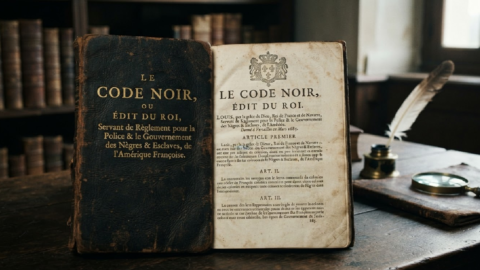
The same papal authority that divided the world between Spain and Portugal also shaped French colonial policy. The Code Noir itself was deeply informed by Louis XIV’s conservative Catholic worldview. The first article of the Code expelled Jews from French colonies. Much of the rest of the Code was based on a “chilling bargain” that slave-trading Catholic countries offered to African captives: they lost their freedom but gained eternal salvation through Christ.
In St. Lucia, the Catholic Church became deeply entangled with the colonial system. French colonists brought Catholicism with them, and after the British took control in 1814, the British found themselves administering to a population that was overwhelmingly Catholic. The clergy in St. Lucia were responsible for keeping parish registers—recording baptisms, marriages, and burials—giving the Church a central role in the lives of both the free and enslaved population.
What Made the French Adaptation Distinctive
The French Code belonged to a grim family of New World slave laws, but several features set it apart :
-
Religious Justification: The Code was deeply informed by Louis XIV’s conservative Catholic worldview. The first article didn’t even mention enslaved people—it expelled Jews from the colonies. The French version of the “chilling bargain” offered to African captives was this: you lose your freedom, but you gain eternal salvation through baptism .
-
State Control: In contrast to the Spanish and Portuguese systems, where the Church had significant independence, the French crown asserted strong control over religious affairs in the colonies. St. Lucia had no bishop—the clergy operated under the authority of colonial administrators, who had the power to discipline and even expel missionary priests . This was a Gallican posture—the French king would not allow Rome to challenge his authority.
-
The Baptism Requirement: Article 2 of the Code required that all enslaved people be baptized and instructed in the Catholic faith. Planters who bought newly arrived enslaved people had to inform the governor within eight days, or face fines. This was not a humanitarian measure—it was about control, tracking the population, and ensuring the colony adhered to the official religion .
-
Sunday Rest: Article 6 mandated that enslaved people be given Sundays and holy days off work. This was a legal requirement that planters often ignored, but it was one of the few provisions that offered enslaved people any respite .
-
Limiting Protestant Influence: The Code also targeted Protestantism. In the decades before the Code, French colonies faced a complex religious landscape. There were French Protestants (Huguenots) who had fled to the Caribbean, along with Dutch and English Protestants who settled nearby. Planters worried about Protestant influence on enslaved people—in part because Protestants from other colonies did not always see baptism as incompatible with freedom . The French crown wanted to prevent Protestant ideas from undermining the social order. The Code made it clear: only Catholics could direct or instruct enslaved people .
-
Controlling Religious Gatherings: The Code restricted enslaved people’s assemblies, requiring any religious gathering to be explicitly approved by the Catholic Church—in a context of security and public order . This meant that only Catholic mass, marriages, and funerals were permitted. Traditional African religious practices were effectively criminalized.
The French Adaptation in Practice
In practice, the French adaptation was often less about protecting the enslaved and more about asserting the crown’s authority. Historian Frédéric Régent notes that Colbert’s goal was not to limit slavery but to ensure that the colonies did not escape royal control.
The Logic Behind the Adaptation
Why did the French go to such lengths to justify slavery in religious terms? The answer lies in a political theory that developed over time—the idea that the stability of these societies required a population that all shared a common set of beliefs that could overcome the hierarchical and racial divisions that fragmented them .
Missionaries, planters, and colonial administrators all played a role in this adaptation. The Code sought to create a society of Gallican Catholics under the king’s authority, where even the enslaved were expected to participate in the rituals of the Church—while simultaneously being excluded from true equality .
Connecting to St. Lucia
In St. Lucia, the French adaptation meant that Catholicism became deeply embedded in the society. The Church kept parish registers—recording baptisms, marriages, and burials. For enslaved people, this created both a record of their existence and a system of control that could be navigated.
A Legacy of Resilience
The French adaptation of the Spanish and Portuguese model was not simply about oppression. It also created legal pathways—through baptism, through marriage, and through military service—that some individuals used to change their status.
Enslaved Africans did not simply accept the system. They learned to navigate it. They maintained their own beliefs and traditions even as they participated in Catholic rituals. They used the law where they could. They resisted where they had to.
The Code Noir was a French adaptation of a model that had already shaped the world. But the enslaved adapted too—in ways that continue to shape St. Lucia today.