
Who Were the First People?
- The Earliest Inhabitants: The very first people in the Caribbean were Archaic Age hunter-gatherers who arrived thousands of years before pottery-using farmers. They were nomadic and left little archaeological trace .
- Igneri (Earlier Wave): They were the earlier arrivals, settling primarily in the Lesser Antilles (including St. Lucia) from around 400 CE. They are often associated with the Saladoid culture, known for their distinctive pottery .
- The Taino (Arawak) Arrival: The Taino, also known as Arawaks, were part of a later migration. They arrived in St. Lucia around 200–400 CE from South America. They brought agriculture (cassava, maize) and pottery, calling the island Iouanalao (“Land of the Iguanas”) .
- Taíno (Later Development): The Taíno emerged later and are associated with the Greater Antilles (Cuba, Hispaniola, Puerto Rico, Jamaica). They developed from earlier Arawak groups (including Igneri-related peoples) into a more complex society with distinct political hierarchies (caciques) and ceremonial centers
Cultural Distinctions
While they shared many traits—farming cassava, fishing, canoe building—the Taíno had a more elaborate social and religious structure:
- Taíno: Had a stratified society with nobles (nitaínos), commoners (naborias), and chiefs (caciques). They built ball courts (batey) and had a complex pantheon of zemís .
- Igneri: Generally considered less politically centralized, though they also built ceremonial centers and were skilled pottery makers .
In short, the Igneri were the foundational Arawak people of the Lesser Antilles, while the Taíno were the more politically complex Arawak civilization that flourished in the Greater Antilles
The Igneri and Taíno are closely related peoples who both spoke Arawakan languages, but they represent different waves of migration and cultural development in the Caribbean.
The Igneri were part of the broader Saladoid culture, known for their advanced pottery (white-on-red designs) and horticulture. They migrated up the island chain from the Orinoco River valley in South America, reaching the Lesser Antilles around 400 CE. On St. Lucia, they would have been the farming communities that the Kalinago later encountered and eventually
The Igneri didn’t disappear—they became the foundation of the historical Kalinago. Their Arawakan language survived as Kalhíphona (Island Carib) until about 1920, and it lives on today as Garifuna, spoken in Central America. So when you hear the Kalinago language, you are hearing the voice of the Igneri.
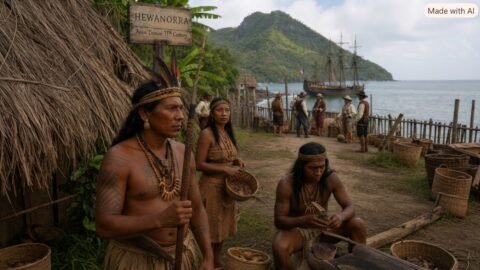
The Kalinago Succession: By 800–1000 CE, the Kalinago (Caribs) arrived and gradually replaced or absorbed the Taino on St. Lucia, renaming it Hewanorra. So, while the Taino were the first known culture to flourish there, they were preceded by earlier, less visible groups, and were later displaced by the Kalinago
The Kalinago Legacy of Survival
The Kalinago were not entirely erased. Today, their descendants live primarily in the Choiseul region on the western coast . Their language is extinct, but their legacy persists in the names they gave the land and in the resilient cultural identity of St. Lucia . Their story is a reminder that the island’s history did not begin in 1500, but in a vibrant, interconnected indigenous world that was fundamentally transformed by conquest.
The history of St. Lucia, seen through the eyes of the Kalinago people, is a story of a maritime world that was violently disrupted. Long before European maps drew borders, the Kalinago moved freely across the islands, treating the sea not as a barrier, but as a highway connecting their communities
A Maritime Dominion
The Kalinago, skilled navigators and canoe builders, arrived in the Lesser Antilles centuries after the Taíno, establishing themselves as the dominant culture on St. Lucia (which they called Hewanorra, meaning “Land of the Iguanas”) . Their society was mobile, with smaller communities linked by trade and travel. Leadership was earned through bravery, and their warrior culture made them formidable defenders of their territory
The Century of Resistance
When Europeans arrived around 1500, they encountered fierce opposition . The Kalinago mounted a resistance that lasted over a century, successfully thwarting early English and Dutch settlement attempts . This period represents the zenith of Kalinago power, as they actively shaped the colonial frontier, preventing St. Lucia from becoming a profitable plantation colony for decades
The Turning Tide
The turning point came in 1660, when the French signed a treaty with the Kalinago and began successful colonization . The introduction of large-scale African slavery for sugar plantations irrevocably altered the demographic and political landscape . As the British and French fought over the island the Kalinago were increasingly dispossessed, their land base shrinking as the plantation economy expanded