
The First Spanish Sighting of St. Lucia: The Full Story
Long before any European ship appeared on the horizon, St. Lucia was already inhabited. This is the story of the island’s first encounter with the Spanish—told through the people who were already there.
The Island Before the Spanish
The first people to settle St. Lucia arrived from South America around 200 to 400 CE. They called the island Iouanalao—the Land of the Iguanas. They farmed, fished, and made pottery.
Between 800 and 1000 CE, another group arrived from the same mainland. They fought the earlier inhabitants and took control of the island, renaming it Hewanorra. These were the Kalinago—a name they used for themselves. They defended their territory fiercely.
To the west, on the larger islands of the Caribbean, lived the Taíno. They were the first Indigenous people Columbus encountered in 1492, on the island they called Ayiti, or Quisqueya—the land now called Hispaniola. The Taíno told the Spanish stories about the Kalinago: stories of raids, warfare, and captivity. These stories spread among the Spanish and shaped how they saw the islands to the east.
The Doctrine of Discovery
Before the Spanish set sail, they carried a set of legal and theological ideas that shaped what followed.
In 1455, the Pope issued Romanus Pontifex, granting Portugal the right to claim lands and peoples in Africa and Asia on the condition that they spread Christianity. In 1493, Pope Alexander VI issued the Inter Caetera, dividing the non-European world between Spain and Portugal. Together, these documents formed what became known as the Doctrine of Discovery—a framework holding that Christian European nations had the right to claim and conquer non-Christian lands and peoples.
This framework justified the seizure of land, the enslavement of Indigenous peoples, and the erasure of their sovereignty.
La Isabela and Hispaniola
In 1493, Columbus returned to the Caribbean with seventeen ships and over twelve hundred men. On the northern coast of Ayiti—in what is now the Dominican Republic—Spanish colonists built La Isabela, the first permanent European settlement in the Americas.
The Taíno initially welcomed the Spanish, offering food, water, and guidance. The relationship changed as the Spanish demanded tribute—gold, cotton, and labor. Those who refused were punished. Those who resisted were killed or captured.
The Taíno fought back. In 1495, a large uprising was crushed. Thousands were taken as captives. Many were shipped to Spain and sold. Others were forced to work in mines and on plantations under the encomienda system—a form of forced labor in which colonists were granted the right to demand labor and tribute from Indigenous communities.
La Isabela struggled from the start. The settlers experienced severe hunger. Many were soldiers and nobles who expected to find gold rather than plant crops. They did not know local agriculture and brought European crops that failed in the tropical climate. Disease swept through the settlement. Two hurricanes struck in 1494 and 1495, destroying buildings and sinking ships. The Taíno stopped trading food as Spanish demands grew harsher.
By 1496, Columbus abandoned La Isabela and moved to the south coast, where Santo Domingo was established.
The First Sighting of St. Lucia
When did the Spanish first see St. Lucia? The exact answer is not known.
By the early 1500s, Spanish ships were moving through the Lesser Antilles regularly, traveling between Hispaniola and South America and raiding Kalinago villages for captives. Hewanorra sat directly on that route.
Some historians believe Columbus sighted the island during his fourth voyage in 1502; others place it earlier, in 1498. A map drawn by Juan de la Cosa in 1500 may show the island. But Columbus never mentioned St. Lucia in his logs, and no Spanish captain left a detailed account of a landing.
What exists is a name: Santa Lucia. Saint Lucy’s feast day is December 13. The name suggests a Spanish sailor sighted the island on that date. The year, the captain, and whether it was Columbus are all unknown.
Sometime between 1498 and 1501, a Spanish ship—likely sailing from Santo Domingo—passed by Hewanorra, saw its mountains, and renamed it Santa Lucia. There was no landing, no agreement, no permission. The Kalinago who lived there may never have known a ship had passed.
The Decree of 1511
On December 23, 1511, King Ferdinand of Spain issued a royal decree in the city of Burgos. It is the first written record naming St. Lucia—Sancta Lucia.
It was not a settlement charter or a trade agreement. It was an authorization for slave raids.
The decree permitted Spanish colonists to wage war on the Kalinago of a specific list of islands, including St. Lucia, Trinidad, Dominica, Martinique, and St. Vincent. It claimed the Kalinago were legitimate targets because they refused Christianity, were said to practice cannibalism, and had killed Spaniards. Any Kalinago captured could be enslaved and sold, with the crown waiving its usual twenty percent tax on profits.
The decree rested on the same logic as the Doctrine of Discovery.
Kalinago Resistance
The Kalinago did not submit.
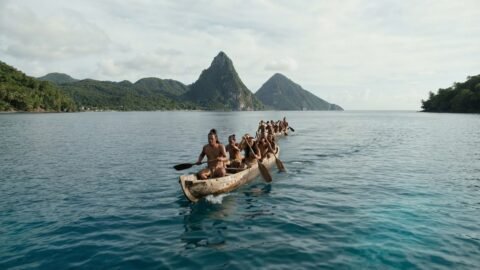
They knew their islands intimately—every cove, mountain pass, and hidden path—and used that knowledge to ambush Spanish landing parties, attacking from the hills and disappearing into the forest. They used poisoned arrows. They were skilled seafarers who traveled between islands in large canoes, warned neighboring islands of approaching ships, and formed alliances.
The Kalinago were part of a broader network across the Lesser Antilles, including St. Lucia, Dominica, Martinique, Guadeloupe, St. Vincent, Grenada, Trinidad, and Tobago. They shared language, culture, and kinship ties, and coordinated resistance across the chain. They also allied with Africans who escaped slavery, forming Maroon communities—especially on St. Vincent.
The Kalinago were themselves captured and enslaved under the 1511 decree and by later English and French colonizers. Thousands were taken over the sixteenth century. But they were never completely defeated.
By the early 1700s, the population had been devastated. A colonial census in 1730 recorded only 37 Kalinago remaining in St. Lucia, alongside 125 white colonists and 175 enslaved Africans. But this was not a complete count. Many Kalinago had moved into the mountainous interior, beyond the reach of colonial officials, or fled to St. Vincent and Dominica. The 37 were those the colonial government could see.
When the English tried to settle St. Lucia in 1605, their colony was reduced from 67 to 19 within weeks. Their second attempt in 1639 lasted eighteen months before the Kalinago destroyed it.
The Garifuna
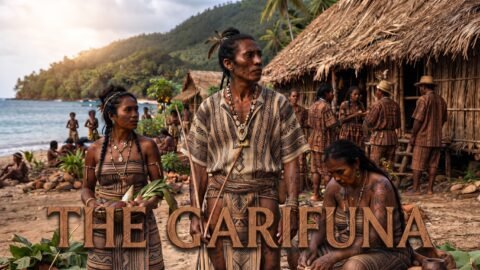
On St. Vincent—which the Kalinago called Hairoun—a new people emerged. Beginning in the 1600s, Africans who escaped slavery arrived on the island. A ship carrying enslaved Africans wrecked off the coast around 1675, and survivors were given refuge by the Kalinago. They intermarried, and their descendants became known as the Garifuna.
The Garifuna combined Kalinago and African heritage, spoke a related language, and adopted Kalinago customs. They resisted French and British colonization for decades. In 1796, British forces defeated a joint Garifuna-Kalinago-French army and deported over 4,000 Garifuna to Balliceaux, where many died. Survivors were exiled to Roatán off Honduras in 1797, and from there the Garifuna spread to Honduras, Belize, Guatemala, and Nicaragua.
The Legacy
The first Spanish encounter with St. Lucia was not a moment of discovery. It was a sighting, a name, and a decree.
But that is only part of the story. The Kalinago did not disappear. Their descendants live on in St. Lucia and across the Eastern Caribbean. The island still carries the name they gave it—Hewanorra—used today at Hewanorra International Airport in Vieux Fort.
The Taíno, too, survived, though their population was devastated. Taíno descendants live on in Cuba, Puerto Rico, the Dominican Republic, and across the diaspora.
The story of St. Lucia’s first encounter with Europeans is a story of two worlds meeting. One sought to conquer. The other determined to survive. In that story, the Kalinago are not footnotes. They are central.